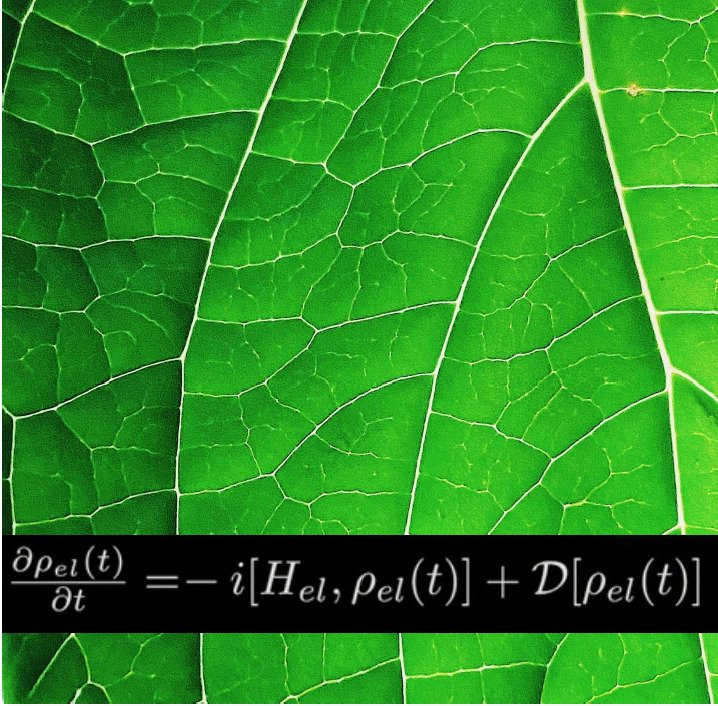
Plants, experts in photosynthesis—absorbing photons and converting them into energy with essentially 100% efficiency—also know about quantum mechanics. To achieve this efficiency, they work with the quantum principle of superposition, in which a particle can be in more than one place at a time.
The photon that reaches the plant, and later gives rise to an exciton, must find the best route to the reaction centre, where it is transformed into energy. It chooses ‘all the routes’, making energy transfer so efficient.
This process takes place with quantum coherence: the state persists long enough to be detected. Quantum coherence is usually achieved in highly isolated environments, at temperatures close to absolute zero.
It sounds simple, but many scientists find it remarkable that such a process can occur under ordinary conditions and temperatures.
Almost 100 years ago, Bohr was already considering the relationship between quantum theory and biology. Schrödinger also discusses it in his 1944 book “What Is Life?”.
Today there is strong evidence of quantum coherence in photosynthesis and quantum tunnelling in enzymes.
I find it fascinating how barriers that once seemed immovable begin to dissolve, and how we move closer to a quantum understanding of everyday reality.
For more on the history of quantum biology, I recommend the Royal Society Publishing article ‘The origins of quantum biology’. doi.org/10.1098/rspa.2018.0674
For an in-depth study presenting direct evidence of quantum coherence in photosynthetic energy transfer, look for ‘Evidence for wavelike energy transfer through quantum coherence in photosynthetic systems’. doi:10.1038/nature05678
If you want to explore how plants use quantum mechanics without diving into research papers, I recommend this video: https://youtu.be/Zc9Xk99gCr4 (Quantum Biology [Part 1] – How Plants Use Quantum Mechanics). #hablarconplantas #comunicacionconplantas #concienciavegetal #espiritudeplantas #sanarconplantas #espiralika